Your Favorite Liberal Arts College Becomes a Trade School
Colleges can't fill their seats. The AI buildout can't find electricians. One fix solves both.

This spring, Hampshire College told its students that the fall 2026 semester would be its last. Nine days later, Anna Maria College, another small Massachusetts school, announced it was closing too, and laid off at least 150 people.
Around the same time, data-center builders were flying construction crews to job sites on private jets. Not executives. Electricians.
Sit with those two pictures for a second. On one side, colleges that can't fill their seats. On the other, an industry so desperate for skilled hands that it's chartering planes to move them around the country.
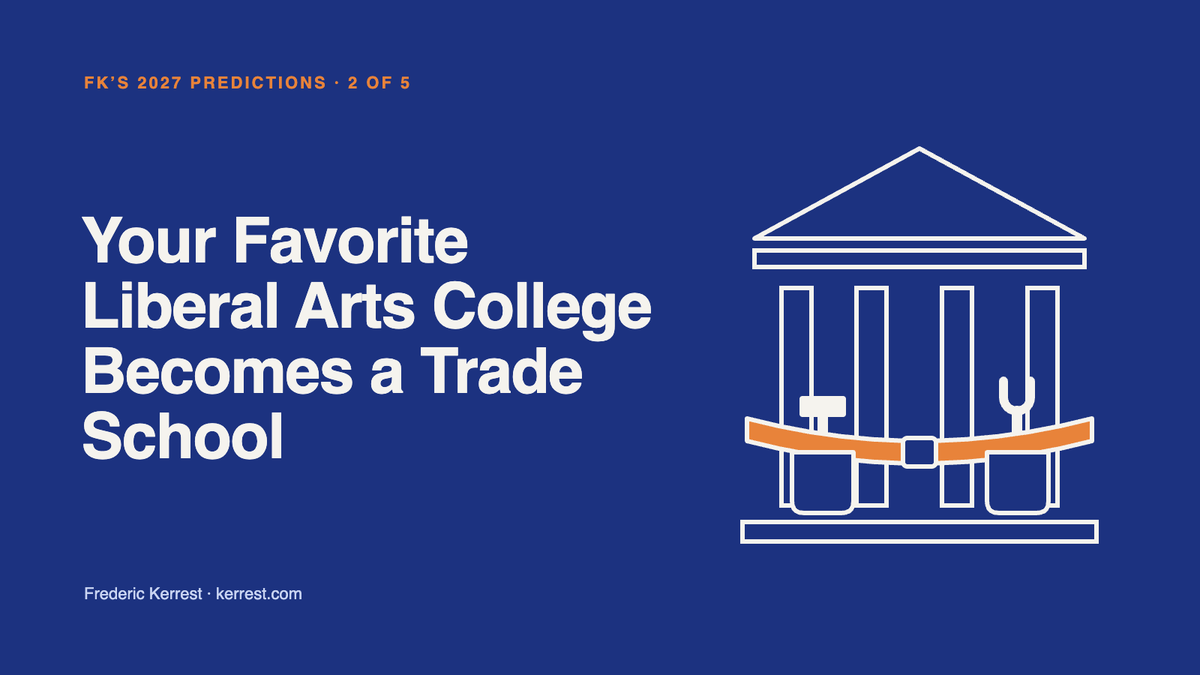
That mismatch is why this prediction is a little provocative: your favorite liberal arts college is going to become a trade school.
I'm not saying everyone's going to become an electrician. I'm saying the system we built no longer matches the economy we live in, and somebody is going to fix it.
The colleges are breaking
If you follow the headlines, you'd think higher education is doing fine. The famous schools are. But the famous schools aren't the story.
The truth is, the pain is concentrated in the small, subscale colleges below the top tier. Huron Consulting projects that 442 of the roughly 1,700 private nonprofit colleges in the US, more than a quarter, could close or merge within ten years. Those schools serve about 670,000 students.
And when a college closes, it isn't just the students who lose. It's the faculty. It's the dining hall staff, the landlords, the coffee shop on Main Street. Whole towns are built around these campuses.
Then there's the promise we've been making to middle-class families for two generations: send your kids to college and they'll be fine. Americans now owe about $1.87 trillion in student loans. About 42% of recent graduates work in jobs that don't need a degree, and recent grads are unemployed at about 5.6%, well above the national rate of about 4%.
That's not how the deal was supposed to work.
The AI buildout can't find the workers
Now look at the other side of the ledger.
Everyone wants to talk about chips and models. But somebody has to build the data centers, and somebody has to wire them. Electrical work is the single biggest cost of building a data center, roughly 40 to 50 percent of the total. Microsoft's president has called the electrician shortage the biggest constraint on the company's US data-center expansion. Not chips. Not land. Electricians.
How big is the gap? The US needs more than 300,000 new electricians over the next decade. And the work pays. The median electrician earns about $62,000 a year, and specialists on data-center sites can make $200,000 or more.
Here's the part I love: students are already figuring this out. Last fall, computer science enrollment at four-year colleges fell 8.1%. Engineering rose 7.3%, and electrical engineering jumped 14%. Young people aren't dumb. They're reading the same signals we are.
Ask yourself: if you were 18 today, which would you pick?
It's every layer of the stack
Let me be clear. This isn't a story about AI wiping out white-collar jobs and sending everyone to the trades. It's more interesting than that.
Before AI showed up, we were already chronically short of software developers. Big employers outside tech, think FedEx in Memphis, Tennessee, or John Deere in Moline, Illinois, struggled for years to hire the engineers they needed. That's a big reason software as a service won: it let companies with scarce engineering talent stop babysitting servers and focus on their actual business. (I may be a little biased on that one.)
Now AI is moving up the stack, from tools that help experts do their jobs to software that does the work itself. To pull that off, you need people at every layer: chips, software, the consultants who help big companies rework how they operate, and the electricians and engineers who make it all physically run.
And it won't happen overnight. Getting AI into large enterprises is going to take years. We've seen this movie before. When we started Okta in 2009, cloud software was about 3% of what companies spent on business applications. It took roughly 15 years to get to two-thirds. AI will move faster, but not as fast as the hype says.
At every one of those layers, we have openings we aren't training people for. The chip industry alone could be short 67,000 technicians and engineers by 2030. We're short everywhere, and nobody owns the pipeline.
Here's what I'd do
Take some of the struggling, subscale colleges, the ones teaching mostly theory to shrinking classes, and repurpose them.
- Build the trades in. Turn spare capacity into programs for high-end electrical, mechanical and power engineering.
- Don't abandon the town. Make it a managed transition for faculty and the community, not a closure.
- Teach management, too. These trades need supervisors, project managers and leaders. That's a career, not just a job.
- Get the builders to pay. The companies spending hundreds of billions on data centers have every reason to fund the pipeline.
- Don't make families choose. Pair technical credentials with a real education, so a kid can get both.
This is already starting. In July, the University of Mount Saint Vincent, a liberal arts school in the Bronx, announced it would host a campus for Apex Technical School, starting with electrical training. Vocational-focused community colleges grew 11.7% last spring. The demand is there. The question is who moves first.
(Before the skeptics weigh in: yes, a liberal arts education has real value. I'm not arguing against Shakespeare. I'm arguing for options.)
My prediction for 2027
In 2027, a well-known private college follows Mount Saint Vincent and opens a trades and technical campus, and I'd bet a data-center builder helps pay for it.
Watch for the first big-name school to say it out loud. When that happens, the stigma breaks, and middle-class families get something they haven't had in a long time: a credible path from school to a well-paid career, without a mountain of debt.
That's two problems solved at once. Struggling colleges get a new mission. The AI buildout gets the people it needs.
So whether you're running a college, building data centers or helping your kid pick a school: look at the jobs, follow the signals, and don't be afraid to pick up a tool belt.
This is the second of my five predictions for 2027. Read the full series.