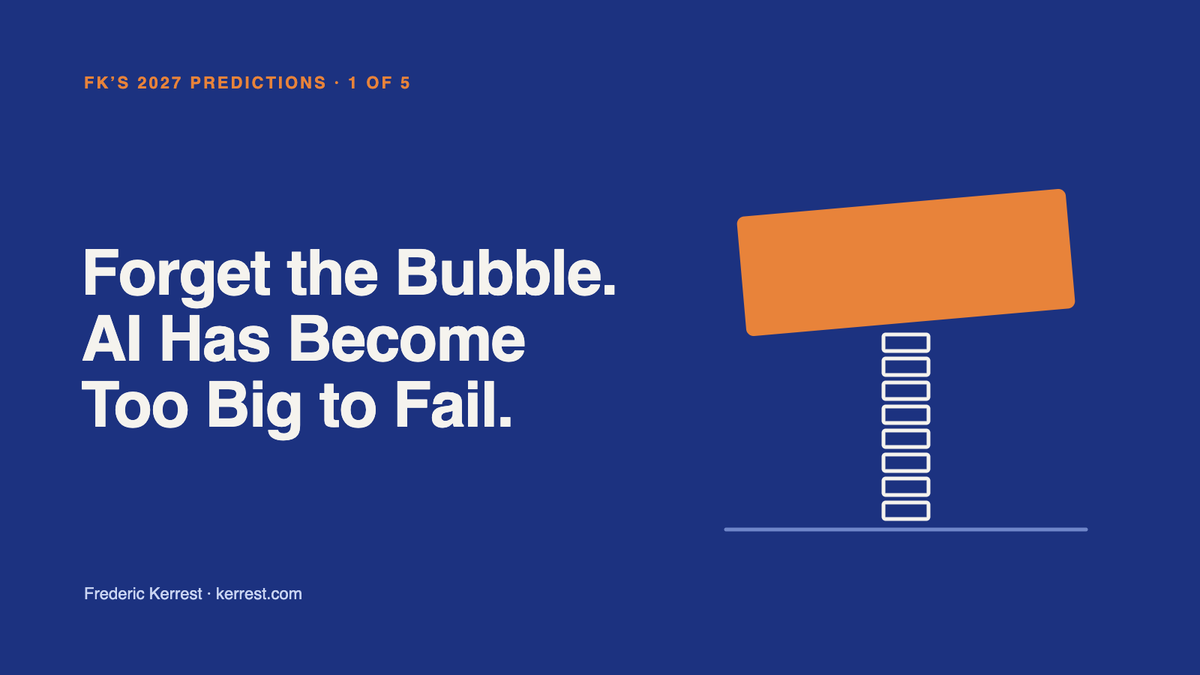
Forget the Bubble. AI Has Become Too Big to Fail.
The real risk isn't a crash. It's how much of the economy now depends on AI.

On November 12, Jensen Huang resigned as CEO of Nvidia, the company he co-founded in 1993 and built into the backbone of the AI economy. He left days after admitting to an extramarital affair with a woman US intelligence reportedly suspects of being a Chinese agent. Nvidia's CFO, Colette Kress, is running the company while the board looks for a successor.
That morning, Nvidia’s stock dropped sharply. Not because its chips got worse. Because one person left. Since its October peak, Nvidia has lost more than $1.6 trillion of market value, roughly what all of Meta is worth.
A week earlier, voters in dozens of towns and counties approved limits on new data centers, and the Nasdaq had its worst day since the tariff shock of April 2025.
That's what the AI debate feels like right now. Everybody's twitchy. And every conversation I have ends with the same question: is the AI bubble going to pop?
Here's my answer. Wrong question.
The economy now runs on AI
Forget whether there's froth. Of course there's froth. The real question is whether AI has become too big to fail.
Start with the money. Amazon, Microsoft, Alphabet and Meta plan to spend more than $700 billion on capital expenditures this year, nearly double last year. Most of it is AI: data centers, chips, power. That spending flows into construction jobs, rents, equipment and local economies all over the country.
It has been carrying a lot of the economy. In the first nine months of 2025, AI-related investment accounted for about 39% of US growth, according to the St. Louis Fed. (Fair caveat: a lot of the hardware is imported, which shrinks the net effect. But the direction is clear.)
Then there's your 401(k). Even after losing nearly a third of its value, Nvidia alone is still about 6% of the S&P 500. The ten biggest stocks are 37% of the index. If you own an index fund, and many of us do, you own a big slice of the AI trade whether you meant to or not.
That's what too big to fail looks like. AI isn't one industry anymore. It's something the whole economy leans on. And as we just saw with Nvidia, sometimes it all leans on one person.
The chasm
Now look at the labs. They're spending hundreds of billions of dollars they haven't made yet. OpenAI raised a record $122 billion this spring, and it has talked about roughly $600 billion of compute spending through 2030. Anthropic is set to price its IPO on November 18, raising as much as $64 billion at a valuation of about $1.4 trillion, one of the largest IPOs ever.
I have a lot of sympathy for the CFOs at these companies. Imagine forecasting demand on a growth curve nobody has ever seen, years out, and then finding the money to build for it. Guess too low and you're out of capacity. Guess too high and you're stuck with billions of dollars of idle machines.
That's the chasm: the gap between the spending today and the revenue tomorrow. How big a gap? The Economist calculates that AI revenue has to grow from the low hundreds of billions of dollars today to about $3 trillion by 2030 just for today's data-center spending to pay off. Bain puts it at $6 trillion by 2031. The question isn't whether there's gold on the other side. It's whether there's enough money to get across.
And the money is getting harder to find. In its latest round, OpenAI set out to raise $30 billion at a $1.4 trillion valuation. As of mid-November, it had gotten about half that, at $1.25 trillion. More of the money behind the big AI labs is coming from new places. Sovereign funds: Abu Dhabi’s MGX closed a fund of about $50 billion this year, and Singapore’s GIC co-led Anthropic’s $65 billion round, alongside Temasek and Qatar’s sovereign fund. Suppliers: Nvidia is financing its own customers, including $30 billion into OpenAI. And private credit, like a $35 billion compute deal for Anthropic.
Venture capital is all in as well. In the third quarter alone, $159 billion of venture money went out globally, 64% of it into AI, including a record 27 rounds of $1 billion or more. Some seed rounds now top $1 billion. (When I started out, a seed round bought you a few laptops and a folding table.)
I'm an investor, so I'll say this carefully: the people best positioned to warn you are often the ones paid to stay bullish. Venture firms earn fees on the money they manage, whether or not the returns ever show up.
Debt is the tell
Here's the signal I watch most closely. When companies that used to print cash start borrowing, pay attention.
Alphabet generated $24.5 billion of free cash flow in the third quarter of 2025. In the third quarter of this year, it was negative $9.1 billion. It has raised about $85 billion of debt this year, including a 100-year bond.
Oracle raised about $43 billion of debt in its last fiscal year and now carries about $130 billion in total. Its credit rating sits one notch above junk.
And when debt gets expensive, they sell stock. Meta is raising up to about $95 billion by selling new shares, including a $60 billion program starting next year. Alphabet sold fresh stock for the first time in twenty years. Companies that spent the last decade buying back their own shares are now selling them.
And the market is noticing. The cost of insuring Oracle's debt against default has roughly doubled. CoreWeave's implies something like a 63% chance of default within five years, and in early November yields on some of its bonds topped 16%. Even Amazon, Alphabet, Meta and Nvidia hit record highs on the same measure. And Bank of America expects AI-related borrowing to grow another 31% in 2027, to $685 billion.
Data centers aren't railroads
The comforting story goes like this. Yes, the railroads went bust in the 1800s, but we kept the tracks. Yes, the fiber companies went bankrupt in 2001, but we kept the fiber, and it gave us the modern internet.
That's not how it works this time.
The buildings will last. The chips won't. Servers are about 60% of what it costs to run an AI data center each year. Big tech companies depreciate them over five or six years, but critics argue their real useful life is two or three, because the next generation is faster, cooler and cheaper to run. By the time some data centers are fully up and running, the chips inside are already yesterday's model.
We're not laying railroad track. We're buying very expensive laptops.
There's a newer risk, too: some of the buildings may never get built. In the November 3 midterm elections, voters approved limits in nearly every data-center measure on the ballot, mostly over power bills. One Wall Street analyst estimates at least 10% of the AI data centers planned in the US just came off the map.
Not a pop. A slow hiss.
So here's my prediction for 2027: no crash. A slow hiss.
Look at the week Nvidia lost its founder. Its stock fell 11%. The S&P 500 went up. Money moved to other chipmakers and kept going. That's what a slow hiss sounds like.
The weaker players deflate. It's already starting: Iren, a smaller AI cloud provider whose stock is down about half since March, just pushed its data-center upgrades and chip purchases into 2027 because money got tight. More of the buildout runs on debt, new stock and sovereign money. And when a major lab wobbles, investors and governments step in, because the alternative hits everyone's retirement account.
Here's what I'll be watching:
- Lab financing rounds. Can they keep raising at these prices?
- Big tech debt. More bonds, or a pullback?
- Nvidia's weight in the index. The more concentrated, the bigger the dependency.
- The cost of insuring AI debt. The market's honest opinion.
- Who runs Nvidia. A new CEO, and whether Nvidia keeps financing its own customers.
- Local votes on data centers. Every moratorium is a data center that doesn't get built.
And keep an eye on one more number: federal debt is now bigger than the entire economy for the first time since World War II.
I'm an optimist. I think AI will change everything. But optimism isn't a financing plan. Watch the debt, watch the dependencies, and don't confuse a slow hiss with a happy ending.
This is the first of my five predictions for 2027. Read the full series.